
Performance marketing has completely changed how businesses advertise in today’s time. Instead of spending money on ads without knowing the results, companies now focus on campaigns where every result can be tracked and measured. This change has made marketing more accountable, data-driven, and result-oriented.
In simple terms, performance marketing is a strategy where advertisers pay only when a specific result is achieved. This method not only reduces risk but also allows businesses to scale their campaigns in real time for better results. From small startups to large companies, everyone is now using performance marketing to grow faster and smarter.
In this guide, we will explore how performance marketing works, why it is important, the key metrics used to measure success, different marketing channels, and the career opportunities available in this field. Whether you are a beginner or someone looking to understand modern marketing better, this article will give you a clear and practical overview.
Difference Between Traditional and Performance Marketing
In today’s digital world marketing has become more dynamic than ever. Should a business rely on traditional or performance marketing, well both have their places-so first understand the two.
Traditional Marketing
Traditional marketing refers to promotional efforts that utilizes offline channels such as radio, television, billboards etc. These channels aims to broadcast a message to large and generalised audience and the key characteristics of it is –
- Broad Reach
- Brand Awareness
- One-way Communication
For example a billboard or a 30 second commercial during prime time or a cricket match will expose your brand to millions. Think about the Fevicol Sofa ad or AXE chocolaty perfume ad. These are memorable ad and contribute to brand image.
However, the major downside of this marketing is to track down it’s actual customers, marketers often rely on estimated impression and post survey campaigns to measure precise ROI.

Performance Marketing
Performance marketing is a data driven and modern approach that produces measurable outcomes. The characteristics of it is –
- Measurable Results
- Data-Driven Optimization
- Two Way Communication
For example running a Facebook ad campaign targeting 35-40 year old professionals in Kolkata can bring instant actionable results. With tools like google analytics and meta ads manager you can see how many people saw your ad, click on it and took action.
As a digital marketing company in India we’ve see how performance marketing transformed businesses and provided scalable results.
Performance Marketing vs Affiliate Marketing
Affiliate marketing has become a common term that gets along with Performance marketing. But the fact is that both are different, affiliate marketing falls under performance marketing which include influencer marketing, email, search and other sources of marketing.
In affiliate marketing a commission is earned for the promotion of a product or services for a third party website, but in recent time it has changed and an affiliate only gets paid after desired result such as sales, clicks etc. It may not assures the brand about their brand image and also whether the consumer will buy their product/services or not.
From this point Performance marketing enters the scene and offers awareness about the product , interest building and precise targeting for desired action. Also it caMetn retarget any customer. With proper strategy, content and targeting even with a small budget any business can successfully build their brand image and drive sales.
Performance Marketing vs Brand Marketing
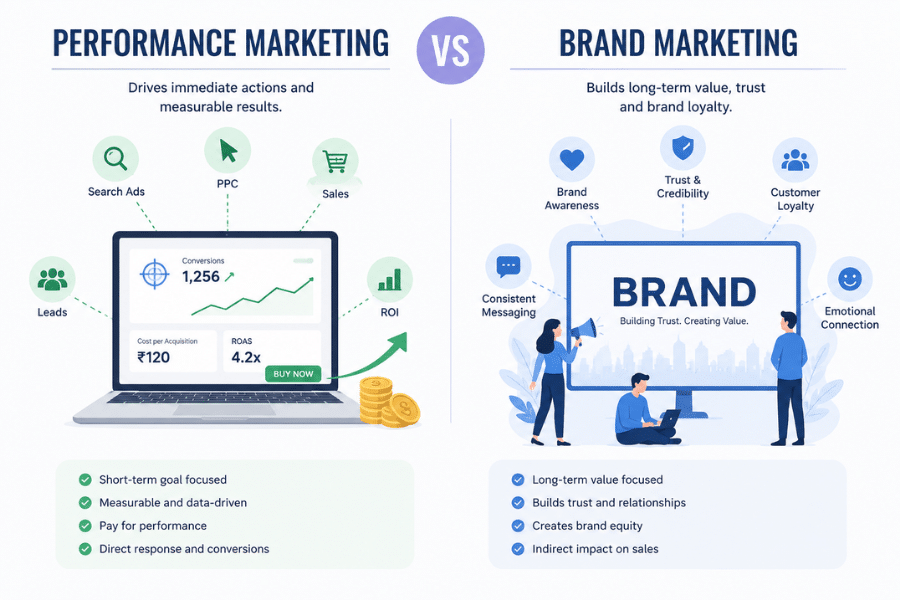
Brand marketing is a high level approach that focuses mainly to share strength, values and emotions of a brand. It is focused on growing awareness as well as product or services of that brand.
Ultimately brand marketing and performance marketing share a common goal, they have their similarities as well as differences such as –
Marketing objects
- Performance Marketing – Designed to deliver immediate and measurable results like clicks, leads and conversions.
- Brand Marketing – Focuses on building brand, strengthening trust and loyalty over time.
Metrics and Measurements
- Performance Marketing – Success is directly measured using metrics like CTR, CPA and ROAS
- Brand Marketing – Relies on brand health metrics like awareness, share of voice and sentiment analysis.
Strategies Used
- Performance Marketing – Leverages high intent, conversion focused tactics like PPC advertising and retargeting.
- Brand Marketing – Uses storytelling tactics like content marketing and sponsorships to build brand perception.

How to Measure Performance Marketing (Key Metrics)
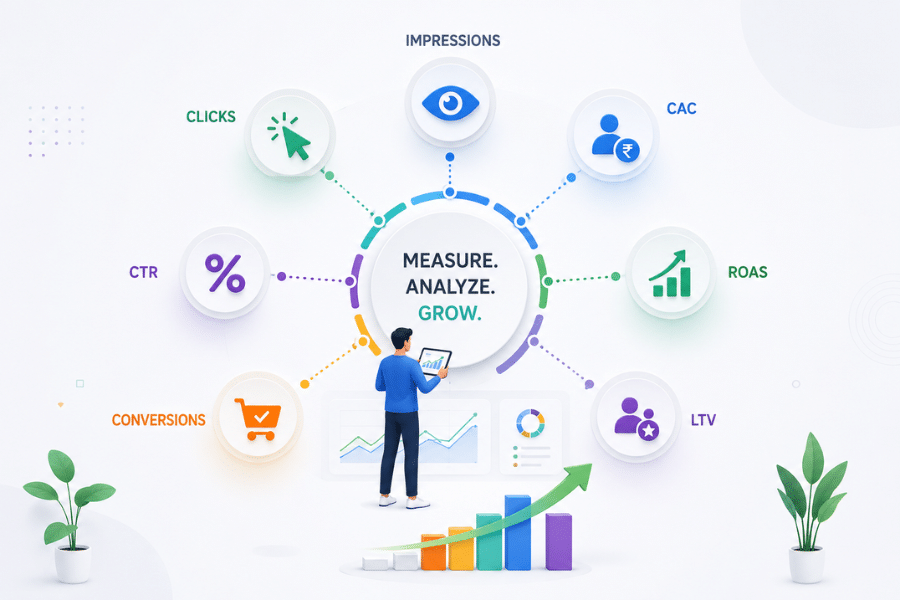
- Impressions – Impression capture the number of times a content has reached to a potential or existing customer. This is used when the goal is visibility, not immediate sales. Higher CPM usually means: More competition, Premium audience, High-demand niche.
- Clicks – The number of clicks is a basic measure that shows how many times a customer click on an ad or go to a website. Example: You spent ₹2,000 ,You got 200 clicks. So, CPC = ₹20.
- Click Through Rate – The CTR is a measure of engagement and quality, if a ad has high CTR, that means that ad is getting high engagement. Example: Ad shown 20,000 times, Got 400 clicks. So, CTR = 2%.
If CTR is low:
- Your headline may be weak
- Your creative may be boring
- Your offer may not be clear
CTR shows how interesting your ad looks.
- Conversion – This is the most important in performance marketing because this is goal. Number of conversions can be counted as the number of people taking the desired action that a performance marketer define as a finish line. Example: 1000 people clicked, 10 people bought, Conversion rate = 1%
If this is low, the problem may not be the ad. It could be:
- Your landing page
- Your pricing
Your trust factors
- Customer Acquisition Cost – CAC is a metric to measure the price your business pays for a user to convert into a sale. If your CAC is higher than your profit per customer, that’s a warning sign.
- Return on AD Spend – In the simplest terms, it’s the equivalent of ROI for ad spending. ROAS helps assess the effectiveness of advertising efforts and how they affect the bottom line.
- Example: You spent ₹50,000, You earned ₹100,000, ROAS = 2x
That means for every ₹1 you spent, you made ₹2. Higher ROAS = better performance.
- Customer Lifetime Value – CLV calculates the total value a paying customer can bring in their entire lifestyle with a brand. Example: A customer buys once for ₹10,000. Then buys again 3 times. Total value = ₹40,000. That’s LTV.
This is important because sometimes you can afford a higher CPA if your LTV is strong.
Why These Metrics Matter
Performance marketing is not about guessing.
It’s about:
- Tracking
- Testing
- Improving
- Scaling
These numbers tell you:
- What to stop
- What to improve
- What to increase
Without metrics, you’re just spending money.
With metrics, you’re making business decisions.

Different Types of Performance Marketing Channels
- Native Marketing – Native ads does not look like ads. They come in the form of suggested articles and it appears by mimicking it’s design, content and writing style.
- Social Media Marketing – With billions of active social media users worldwide, marketers look to utilize this by targeting Facebook, Instagram, Twitter, Linkedln and others to scale their campaigns and or just create brand awareness.
- Search Engine Marketing – With search engine performance marketer shows ads on various search engines like Google, Yahoo, Bing and others.
- Email Marketing – Performance marketer uses email marketing when they want to form a direct communication with their customers, using targeted email to promote products, services etc
Why Choosing the Right Channel Matters
Not every channel works for every business.
Example: If you sell laundry services, Google Ads may work better because people search urgently. The smart approach is test different channels, measure performance, scale what works.
Benefits of Performance Marketing
Performance marketing has become one of the most powerful strategies in digital marketing because advertisers measure results based on their ad spend. Unlike traditional marketing performance marketing ensures results such as clicks, leads, or sales.
Here are the key benefits of performance marketing:
1. Pay for Actual Results
The biggest advantage of performance marketing is you only pay for performance. This reduces financial risk and increases accountability.
2. Highly Measurable and Data-Driven
Performance marketing runs on data.
You can track:
- Click-through rate (CTR)
- Conversion rate
- Cost per acquisition (CPA)
- Return on ad spend (ROAS)
- Customer acquisition cost (CAC)
Because every interaction is tracked and This type of transparency is not possible in traditional marketing.
3. Better Budget Control
Campaigns are optimized based on real-time metrics so businesses have full control over their ad spend. This flexibility allows businesses to maximize returns.
4. Improved Targeting Capabilities
Performance marketing platforms like search engines and social media networks offer advanced audience targeting.
You can target users based on:
- Demographics
- Interests
- Online behavior
- Purchase intent
- Location
- Device type
This precise targeting increases conversion rates.
5. Scalability
Once a campaign proves profitable, scaling becomes easy which makes performance marketing ideal for startups, ecommerce brands etc.
6. Clear ROI Tracking
Return on investment is one of the most important business metrics.
Performance marketing makes ROI tracking simple and transparent. You can clearly calculate:
Revenue Generated – Ad Spend = Net Profit
This transparency helps performance marketers make better judgements.
Performance Marketing Doesn’t Guarantee Overnight Success
One of the biggest myths about performance marketing is that it produces instant results. Because it’s data-driven and easily measured many thinks results will be immediate.
That is not how it works.
Performance marketing issimple — but it is not magic.
1. Data Takes Time to Optimize
Performance marketing platforms depends on data. Whether you’re running search ads, social ads, or anything the system needs enough data to learn:
- Which audience converts best
- Which creatives perform better
- Which placements generate higher ROI
- What bidding strategy works most efficiently
Results requires patience and proper testing.
2. Strong Offers Matter More Than Ads
No campaign can fix a weak offer.
If your pricing is wrong, landing page confuses people – no amount of ad spend will generate results.
3. Competition Impacts Performance
As of now more businesses are investing in digital advertising so competition is increasing everyday.
This means:
- Higher cost per click (CPC)
- Increased cost per acquisition (CPA)
- Aggressive bidding wars in competitive industries
Long term success requires strategy — better creatives, better targeting, and better positioning.
4. Continuous Testing Is Required
Performance marketing is not a “start and forget” system – Markets change, Trends change, Audience evolves, Platforms update systems.
Good campaigns today may underperform tomorrow.
Consistent testing of:
- Ad creatives
- Landing pages
- Audiences
- Offers
necessary to maintain profitability.
5. Tracking Must Be Accurate
Many campaigns fail not because the ads are bad — but because tracking isn’t accurate.
If conversion tracking, pixels, or analytics are not properly managed:
- You cannot measure true ROI
- You cannot optimize effectively
Performance marketing depends entirely on clean, reliable data.
How to Get Started with Performance Marketing
Getting started with performance marketing requires more than ads and budget. A structure and a data-driven approach is needed results.
Here is a step-by-step roadmap to begin effectively.
Step 1: Before starting decide what results you want.
Step 2: Performance marketing works best when you know your target.
Step 3: Different results require different platforms so Choose channels based on results and target
Step 4: Proper budgeting increase your chances of success, this isn’t about whom spends more.
Step 5: Only ads do not convert, landing pages do. A bad landing page can destroy best ad campaign.
If you are new to digital marketing and want to build a career in performance marketing, enrolling in a Digital Marketing Course in Kolkata can help you develop practical skills in Google Ads, Meta Ads, Google Analytics, SEO, conversion tracking, and campaign optimization. A structured training program provides hands-on experience with real-world projects, making it easier to understand how performance marketing campaigns are planned, executed, and scaled for business growth.
How AI Works in Performance Marketing
Artificial Intelligence (AI) has become a trusted tool behind modern performance marketing. Advertising platforms such as Google Ads and Meta Ads are heavily depended on AI algorithms that analyse data in real time.
AI does not replace marketers — it enhances their performance.
Let’s see how –
1. AI in Smart Bidding and Budget Optimization
AI-driven systems automatically adjust bids based on:
- User behavior
- Device type
- Location
- Time of day
- Past conversion probability
- Audience intent signals
This ensures maximum Return on Ad Spend (ROAS).
2. Predictive Audience Targeting
AI analyses past data to identify patterns in:
- Converting customers
- High-value buyers
- Repeat purchasers
- Engaged users
Instead of guessing who might convert, AI predicts who is most likely to convert.
3. Real-Time Data Analysis
Monitoring every campaign 24/7 is humanly not possible.
AI systems:
- Detect performance drops
- Identify unusual spikes in cost
- Spot high-performing segments
- Recommend optimization actions
This stops wasted ad spend.
4. Customer Journey Personalization
AI tracks user behavior across all platforms:
- Website visits
- Ad interactions
- Email engagement
- Previous purchases
This increases conversion rates because users see relevant content.
6. Fraud Detection
AI systems also help identify:
- Click fraud
- Bot traffic
- Fake installs
- Invalid conversions
By filtering low-quality traffic, AI protects advertising budgets and improves campaign.
In 2026 and beyond, performance marketing without AI support is almost impossible at scale.
Challenges in Performance Marketing
While performance marketing offers outstanding results and growth but it is not without challenges. Many people thinks that because results are trackable, success is guaranteed. In reality, performance marketing requires constant effort, strategic thinking, proper funnels and accurate landing page.
Here are the major challenges marketers face:
1. Rising Competition and Increasing Costs
2. Ad Fatigue and Creative Burnout
3. Tracking and Attribution Issues
4. Platform Dependency Risk
5. Data Overload and Misinterpretation
6. Short-Term Focus Over Long-Term Brand Building
7. Learning Curve and Technical Complexity
8. AI Dependence Without Strategy
The Reality
Performance marketing is powerful — but it is not “start and forget.”
It demands:
- Continuous testing
- Analytical thinking
- Strategic adjustments
- Strong fundamentals
Businesses that treat it casually lose money. Businesses that approach it scientifically gain proper results.
Performance Marketing Job Roles
Performance marketing is not a single job. It is a specialized field with multiple career paths
Here are the key job roles in performance marketing:
1. Performance Marketing Executive
2. Paid Media Specialist
3. Performance Marketing Manager
4. Growth Marketer
5. Media Buyer
6. Affiliate Marketing Manager
7. Performance Marketing Analyst
Skills Required in Performance Marketing Jobs
To succeed in any of these roles, you need:
- Strong analytical thinking
- Knowledge of ad platforms
- Understanding of KPIs and metrics
- Budget management skills
- Basic copywriting knowledge
- Conversion funnel understanding
Most importantly — you need a mindset.
Career Growth Path
Typical growth progression:
Intern → Executive → Senior Executive → Manager → Growth Lead → Head of Performance → Digital Marketing Director
Why These Roles Are in High Demand
Companies today care about revenue, not just visibility.
Performance marketers directly impact:
- Sales
- Lead generation
- Profit margins
That makes these roles revenue-generating positions, not just support roles — which increases their value in the job market.
Performance Marketing Salary in India
Performance marketing is not just a demanding skill, right now it’s also a high paying career. Especially if you’re experienced, deliver results and know how to grow a business.
At the entry level, a Performance Marketing Executive or fresher can expect to earn around ₹2.5 LPA to ₹4 LPA. At this stage, most of the work involves running ads, tracking metrics, and learning platforms like Google Ads and Meta Ads.
With 2–5 years of experience, professionals move into roles like Paid Media Specialist or Senior Executive, where salaries typically range between ₹5 LPA to ₹10 LPA. Here, the focus shifts more towards campaign optimization, strategy, and improving ROI.
At the managerial level (5–8 years of experience), a Performance Marketing Manager can earn anywhere between ₹10 LPA to ₹20+ LPA, depending on the company and the size of ad budgets they handle. These roles involve decision- making, team management, and scaling campaigns profitably.
For highly experienced professionals such as Growth Marketers or Heads of Performance, salaries can go beyond ₹25 LPA, especially in startups, agencies, or international companies.
Another important thing to understand is that performance marketing is a skill-based field, not just degree-based. Many freelancers and consultants also earn significant income by managing campaigns for multiple clients, sometimes even more than full- time professionals.
In simple terms, the better results you generate (more sales, better ROI), the higher your earning potential becomes in performance marketing.
Conclusion
Performance marketing has transformed how businesses approach advertising in the digital era. Instead of spending money on uncertain exposure, companies now invest in measurable actions such as clicks, leads, sales. This shift toward accountability and data-driven decision-making makes performance marketing one of the most powerful strategies in modern digital marketing.
However, performance marketing is not a shortcut to instant success. It requires clear objectives, continuous testing, strong analytics, creative strategy, and constant optimization.
From startups to large enterprises, organizations rely on performance marketing to control budgets, track ROI, and drive predictable revenue. At the same time, it opens strong career opportunities for professionals who understand metrics, platforms, and growth strategies.
In a digital-first world where every click can be tracked and every action can be measured, performance marketing is not just a trend — it is a necessity for sustainable business growth.
About the Author
Hi, I’m Payod, an aspiring digital marketer with a keen interest in performance marketing and paid advertising. Through hands-on experience with Meta Ads and continuous learning, I am developing skills in campaign management, audience targeting, and performance analysis.
This article is based on my research and practical learning throughout my digital marketing training under the guidance of Mrinal Sir, whose practical teaching approach and industry insights have helped me build a strong foundation in digital marketing.
