
Most people who visit a website for the first time never buy anything. They read, they scroll, they leave. Then, weeks later, they come back on their own terms and finally take action. This is not a broken system. This is exactly how buying decisions work.
Marketers have a name for this pattern: the marketing funnel. If you are trying to make sense of digital marketing as a subject, whether out of curiosity or because you are exploring a digital marketing course in Kolkata to build a career in the field, understanding this concept early will make everything else click faster. SEO, social media, ads, email, all of it fits inside this one framework.
In this guide, you will learn what a marketing funnel is, how the TOFU, MOFU and BOFU stages work, and how marketers actually use this thinking to plan content and campaigns.
What Is a Marketing Funnel?
A marketing funnel is a model that shows how a person moves from first hearing about a brand to finally taking action, such as buying, signing up, or enquiring.
Here is a simple example. Suppose someone searches why is digital marketing important. They land on a blog post. They read it, learn something useful, and leave. A few days later, they search digital marketing skills for beginners and land on another article from the same website. Slowly, they start recognising the brand. Eventually, they search for a course near them and enquire. That entire journey is the funnel in action.
It is called a funnel because a large number of people enter at the top, out of curiosity or general interest, and a smaller number make it to the bottom, ready to act. Not everyone converts, and that is expected. The funnel simply describes where each visitor stands in their decision-making process.
One important note: real customer journeys are rarely a straight line. People jump between stages, revisit content, or skip steps entirely. The funnel is a planning tool, not a strict rulebook.
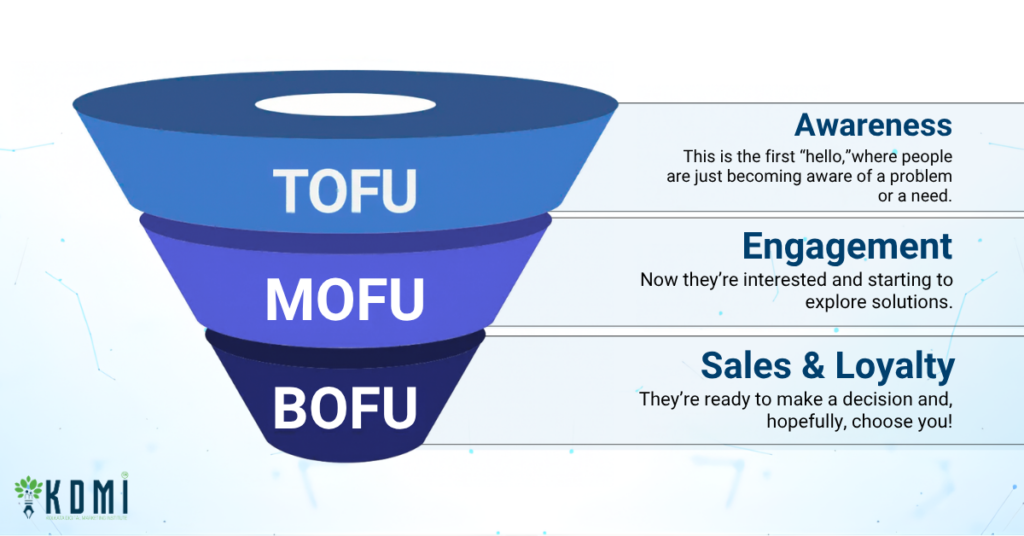
Marketing Funnel Stages
Most marketers break the funnel into three core stages: TOFU, MOFU and BOFU. These stand for Top, Middle and Bottom of the funnel.
| Stage | Customer mindset | Main goal | Content examples |
| TOFU (Awareness) | I have a question or a problem | Educate and build trust | Blog posts, explainer videos, social posts |
| MOFU (Consideration) | I am comparing my options | Nurture and guide the decision | Comparison guides, webinars, email series |
| BOFU (Decision) | I am ready to choose | Convert into action | Case studies, demos, course pages, testimonials |
Each stage needs a different tone, different content, and a different goal. Mixing them up is one of the most common mistakes marketers make, and we will cover that later.
TOFU: Top of the Funnel
TOFU stands for Top of the Funnel. This is the awareness stage, where someone realises they have a problem, a question, or a curiosity worth exploring.
People at this stage are not thinking about any specific brand. They are thinking about themselves. Someone typing how does digital marketing work is not ready to enrol anywhere. They just want clarity.
What the user is thinking: I want to understand this topic.
Main objective: Educate, inform, and earn attention without asking for anything in return.
Search intent: Purely informational. Broad, curious, exploratory queries.
SEO strategy: Target beginner-friendly, high-volume informational keywords. Focus on clear definitions, simple language, and genuinely useful explanations rather than sales pitches.
Content types that work well:
- Beginner guides and explainer blog posts
- “What is” and “how does” style articles
- Short educational videos and reels
- Infographics that simplify a concept
- Social media carousels that break down a topic
For example, a short Instagram reel titled 3 digital marketing skills every beginner should know is a classic TOFU piece. It teaches something useful and does not push a sale. That is the whole point of this stage. If TOFU content feels like an advertisement, it usually fails, because the reader was not looking to buy anything yet.
MOFU: Middle of the Funnel
MOFU stands for Middle of the Funnel, also called the consideration stage. By now, the person already understands the basic problem. They are actively comparing solutions.
How this audience differs from TOFU: They are no longer asking what is this. They are asking which option is right for me.
Search intent: Commercial investigation. Queries include comparisons, reviews, and “best” or “vs” style searches.
Content types that work well:
- Comparison articles (for example, “online vs offline learning”)
- Checklists and buyer’s guides
- Webinars and detailed how-to content
- Email newsletters that nurture interest over time
- Case studies that show real outcomes
Lead generation usually starts here. A visitor might download a free guide or join an email list in exchange for their contact details. This lets a brand continue the conversation instead of relying on the person to return on their own.
For instance, someone researching how to switch careers into digital marketing might read an article comparing different learning paths, such as self-study versus structured training. That article sits firmly in MOFU. It respects that the reader is already convinced digital marketing matters. Now they need help choosing a direction.
BOFU: Bottom of the Funnel
BOFU stands for Bottom of the Funnel, the decision stage. This is where someone is close to taking action and just needs a final push of confidence.
Buyer intent: High. The person has usually narrowed their options down to one or two choices.
What they are looking for: Proof, reassurance, and a clear next step.
Content types that work well:
- Detailed service or course pages
- Reviews and testimonials
- Case studies with specific outcomes
- Pricing and comparison pages
- Demo requests or free consultation offers
- Direct contact or enquiry pages
BOFU users are close to converting, so this content can be more direct. A course page that clearly explains what is taught, who it suits, and how to enrol is a good BOFU example. Unlike TOFU content, being straightforward here is appropriate because the reader already wants this information.
TOFU vs MOFU vs BOFU
Here is a side-by-side comparison to make the differences clear.
| Factor | TOFU | MOFU | BOFU |
| Audience awareness | Low | Medium | High |
| Search intent | Informational | Commercial investigation | Transactional |
| Main goal | Educate and build trust | Nurture and guide | Convert |
| Example query | What is digital marketing | Best digital marketing course in Kolkata | Digital marketing course fees |
| Example CTA | Read more | Download the guide | Book a free demo |
| Key metric | Traffic, impressions, time on page | Leads, email signups, engagement | Conversion rate, enquiries, enrolments |
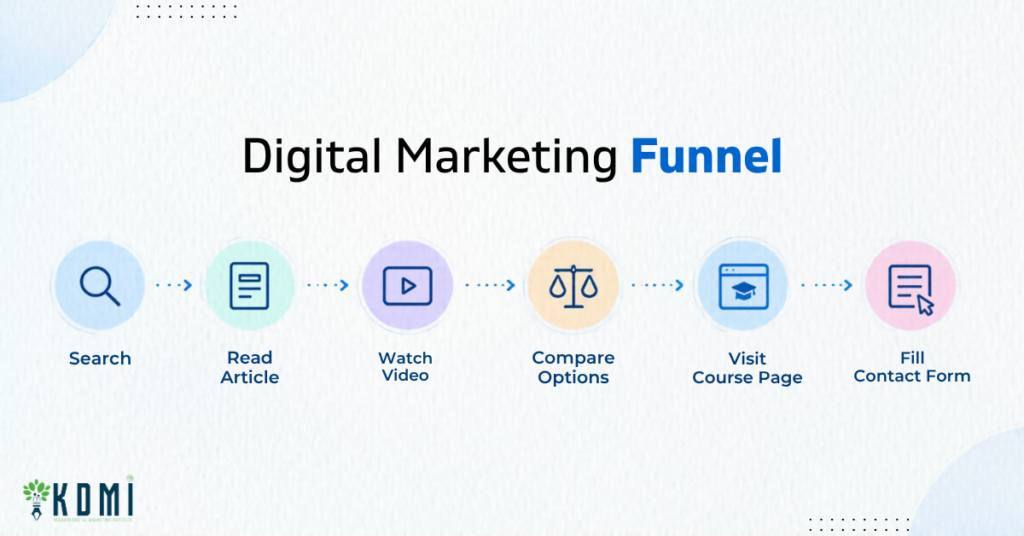
Example of a Digital Marketing Funnel
Let’s walk through a realistic journey. Meet Priya, a graduate exploring career options.
- Search: Priya types “is digital marketing a good career” into Google.
- Educational content (TOFU): She reads a blog post explaining what the field involves and which skills matter.
- More research (TOFU to MOFU): Over the next few days, she searches “digital marketing skills for beginners” and watches a few explainer videos.
- Course comparison (MOFU): She starts comparing training options, reading about course structure, practical exposure, and placement support.
- Course page (BOFU): She visits a specific course page, checks the curriculum, and reads student testimonials.
- Enquiry (Conversion): She fills out a contact form or calls to ask about batch timings.
Notice how each step naturally answers a slightly more specific question than the last. That progression is the funnel doing its job. Nobody forced Priya through it. Good content simply met her at each stage of her own thinking.
How SEO Fits Into a Marketing Funnel
SEO is not just about ranking for one keyword. It works best when it targets different search intents across the entire funnel.
Informational keywords (TOFU): “what is digital marketing,” “how does SEO work.” These attract the widest audience but convert the least directly.
Commercial investigation keywords (MOFU): “best digital marketing course,” “SEO vs Google Ads for beginners.” These attract people actively evaluating options.
Transactional keywords (BOFU): “digital marketing course in Kolkata fees,” “enrol digital marketing training.” These attract people ready to act.
A smart internal linking strategy connects these stages. A TOFU article about “what is digital marketing” can link to a MOFU article comparing skills or career paths, which can then link to a BOFU course page. This is often called a topic cluster, where multiple pieces of content link back and forth around one central theme.
This matters because most visitors will not convert on their very first visit. Internal links give them an easy way to keep exploring without needing to search again, which keeps them within your site and closer to a decision.
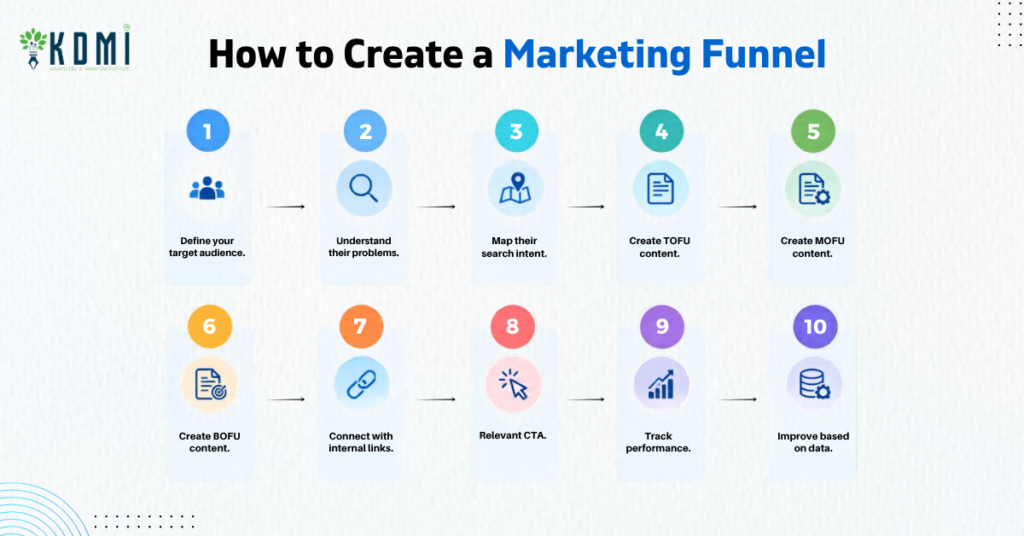
How to Create a Marketing Funnel
Building a funnel does not require complicated tools. Here is a simple step-by-step process.
- Define your target audience. Know who you are trying to reach and why.
- Understand their problems. List the questions and challenges they face before considering your product or service.
- Map their search intent. Group their likely queries into TOFU, MOFU and BOFU.
- Create TOFU content. Focus on education, not promotion.
- Create MOFU content. Help them compare and evaluate options.
- Create BOFU content. Make the decision and next step obvious.
- Connect content with internal links. Guide readers naturally from one stage to the next.
- Add relevant CTAs. Match the call to action to the stage, do not ask a TOFU reader to “buy now.”
- Track performance. Monitor how people move (or don’t move) between stages.
- Improve based on data. Update weak-performing content and double down on what works.
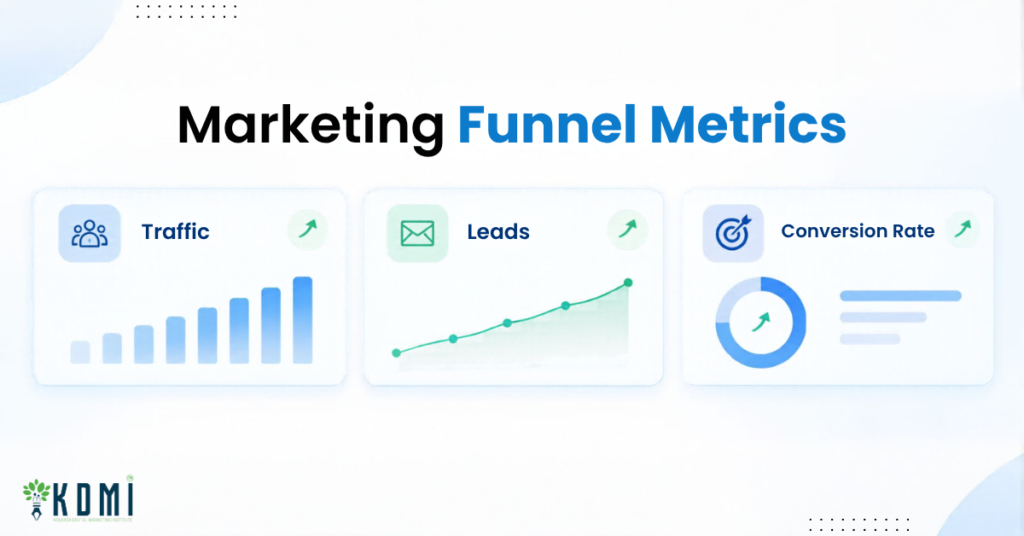
Marketing Funnel Metrics
You do not need to track everything. Focus on a handful of metrics that map to each stage.
- Organic traffic and impressions: How many people are discovering your TOFU content.
- Click-through rate: Whether your titles and snippets are compelling enough to earn clicks.
- Engagement and time spent: Whether people are actually reading or watching, not just landing and leaving.
- Leads: How many visitors share contact details or sign up for more information.
- Conversion rate: The percentage of visitors who complete the desired action.
- Cost per lead and customer acquisition cost: Relevant mainly for paid campaigns.
- Revenue and ROI: The ultimate measure of whether the funnel is working.
Tracking too many numbers at once usually causes confusion. Start with traffic, leads, and conversion rate. Add more only once you are comfortable reading these three.
Common Marketing Funnel Mistakes
Even experienced marketers fall into these traps.
- Selling too early. Pushing a sales pitch on someone who just discovered your brand feels pushy and drives them away.
- Creating content without matching search intent. Writing a “best course” comparison for a keyword that is purely informational wastes effort.
- Ignoring TOFU entirely. Without awareness content, there is no fresh audience entering the funnel at all.
- Ignoring MOFU. Jumping straight from awareness to a hard sell skips the trust-building step most people need.
- Only creating BOFU pages. A site full of “buy now” pages with no educational content struggles to attract organic traffic.
- Weak internal linking. Readers finish one article and have nowhere useful to go next.
- No clear CTA. Every piece of content should tell the reader what to do next, even if it is simply “read this related guide.”
- Not measuring results. Without tracking, you cannot tell which stage is underperforming.
Marketing Funnel vs Customer Journey
These two terms are related but not identical. The marketing funnel is a simplified model marketers use to plan content and campaigns around stages of awareness. The customer journey is the actual, often messy, path a real person takes, including every touchpoint, device, and detour along the way.
Think of the funnel as a map and the customer journey as the actual road trip. The map helps you plan, but the real trip includes wrong turns, stops, and shortcuts the map does not show.
Is the Marketing Funnel Still Relevant?
Yes, though modern customer journeys look less like a straight line than they used to. People now discover brands through many entry points at once, including:
- Google search
- YouTube videos
- Instagram and other social platforms
- Community discussions on Reddit and forums
- AI-powered search tools
- Online reviews
- Word-of-mouth recommendations
Someone might see a brand on Instagram, later find it again through a Google search, and finally decide after reading reviews. That is not a broken funnel. It is simply a funnel with more entry points than before.
The core idea still holds: people move from unaware to aware, from curious to convinced, and eventually to a decision. The framework remains a useful way to plan content, even if the real path rarely looks perfectly linear.
Why This Matters If You Want a Career in Digital Marketing
Understanding funnels is not just theory. It is one of the first practical frameworks used across SEO, content marketing, social media, and paid advertising. Every digital marketing skill you learn, whether it is writing blog content, running Google Ads, or managing a social media page, exists to serve one of these three funnel stages.
If you are exploring digital marketing as a subject or a career, this is exactly the kind of foundational thinking covered in a structured digital marketing course. Beginners often start by learning individual tools like SEO or social media marketing without understanding how they connect. Learning the funnel first makes every other skill easier to apply with purpose.
