
If you want your website to rank, keyword research is your starting point. It shows what people are searching for and helps your content match their intent. But doing it manually can be slow and tiring.
That is where ChatGPT makes the process effortless.
With the right prompts, you can generate fresh keyword ideas, uncover intent, and build long-tail lists in minutes.
This guide will show you exactly how to use ChatGPT to make keyword research faster, smarter, and beginner-friendly.
Why Use ChatGPT for SEO Keyword Research?
Most traditional tools like Ahrefs, SEMrush, or Google Keyword Planner are powerful, but they come with challenges. They can be expensive, difficult for beginners, and often overwhelm you with data instead of clear direction.
ChatGPT fills that gap by acting as a fast, flexible, always-available research partner. With the right prompts, it can help you spark new keyword ideas, uncover long-tail opportunities, understand search intent, spot content gaps, and even group keywords into meaningful clusters.
It is quick, cost-effective, and makes keyword research easier for both beginners and experienced SEOs.

How to Do Keyword Research Using ChatGPT for Digital Marketing (With Practical Prompts)
Keyword research is the backbone of every successful digital marketing strategy. Whether you work in SEO, performance marketing, or content marketing, choosing the right keywords ensures your content reaches users who are actively searching for your services.
ChatGPT can act as a powerful keyword research assistant when used with structured prompts. Below is a step-by-step process showing how digital marketers can use ChatGPT effectively for keyword research.
Step 1: Define Your Digital Marketing Focus
Before generating keywords, clearly define your digital marketing niche. This helps ChatGPT understand the context and generate intent-driven keywords instead of generic ideas.
Ask yourself:
- Am I targeting SEO, Google Ads, or social media marketing?
- Is my audience beginners, business owners, or advanced marketers?
- Am I promoting a service, course, or informational content?
Prompt Example:
“I run a digital marketing blog focused on SEO, Google Ads, and performance marketing. Can you suggest keyword ideas people search for related to digital marketing services and strategies?”
This ensures the output aligns with real search behaviour, improving relevance and topical authority.
Step 2: Generate Seed Keywords for Digital Marketing
Seed keywords are broad phrases that define your core topic. These keywords help in building the foundation of your SEO strategy and identifying content opportunities.
Prompt Example:
“Give me 15 seed keywords for digital marketing and performance marketing.”
Example Output:
- digital marketing services
- SEO strategies
- performance marketing
- Google Ads management
- social media marketing
- content marketing strategy
- online marketing agency
These seed keywords help establish topical relevance, a key factor in Google’s EEAT framework.
Step 3: Expand Seed Keywords into Long-Tail Keywords
Long-tail keywords reflect specific user intent and usually have lower competition. They are extremely valuable for blogs, landing pages, and service pages.
Prompt Example:
“Generate 20 long-tail keyword ideas for the seed keyword ‘SEO services’.”
Examples:
- affordable SEO services for small businesses
- SEO services for local businesses in India
- How to choose the right SEO agency
- SEO services for e-commerce websites
- monthly SEO packages for startups
Using long-tail keywords increases conversion potential and helps attract highly targeted traffic.
Step 4: Identify Search Intent for Digital Marketing Keywords
Understanding search intent helps you create the right type of content for each keyword. ChatGPT can quickly clarify whether a keyword is informational, commercial, or transactional.
Prompt Example:
“What is the search intent for the keyword ‘Google Ads agency for small businesses’?”
Expected Insight:
The intent is transactional/commercial. The user is looking to hire a service provider and is close to making a decision.
This insight helps you decide whether to create a blog, service page, or landing page.
Step 5: Group Keywords into SEO Topic Clusters
Keyword grouping helps in building content silos, which improves internal linking, crawlability, and topical authority.
Prompt Example:
“Group the following keywords into topic clusters: SEO audit services, on-page SEO checklist, technical SEO guide, best SEO tools, keyword research tools.”
Example Clusters:
SEO Tools
- best SEO tools
- keyword research tools
SEO Services & Guides
- SEO audit services
- on-page SEO checklist
- technical SEO guide
This structure supports scalable SEO growth and improves user experience.
Step 6: Find Content Gaps in Digital & Performance Marketing
Content gaps are topics your competitors have not fully covered. Publishing content on these gaps helps you rank faster and establish industry expertise.
Prompt Example:
“What are some content gaps in SEO and performance marketing that most blogs don’t cover?”
Example Ideas:
- SEO strategies for AI-generated content
- Performance marketing for local service businesses
- Common Google Ads mistakes by beginners
- SEO vs performance marketing for startups
Covering these topics positions your brand as a knowledge leader, which strengthens trust and authority.
So, ChatGPT is not a replacement for advanced SEO tools, but it is an excellent idea-generation and intent-analysis tool for digital marketers.
When used correctly, ChatGPT helps you:
- Generate relevant keyword ideas faster
- Understand search intent clearly
- Plan content clusters strategically
- Discover untapped digital marketing topics
By combining ChatGPT insights with real keyword data and experience, you can create high-quality, EEAT-compliant content that ranks, converts, and builds long-term authority.
ChatGPT Prompts for SEO Keyword Research
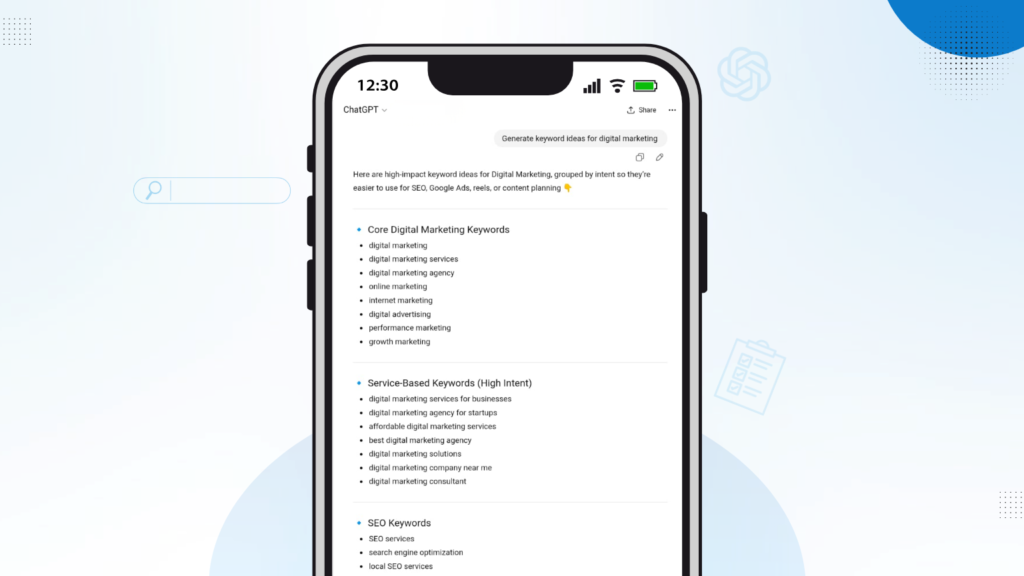
Here’s a list of categorized, ready-to-use prompts for all your keyword research needs:
Seed Keyword Generation
1. “List 20 broad keywords related to [your topic].”
2. “What are some trending keywords in [industry] right now?”
3. “Give me keywords people search when they are just getting started with [topic].”
New Keyword Ideas from a Seed Word
Seed words are basic keywords or themes that you can expand into dozens of variations with the help of ChatGPT.
4. “Generate fresh keyword ideas based on the seed word ‘[insert keyword]’.”
5. “Give me niche-specific keyword ideas using the seed keyword ‘[topic]’.”
6. “What are trending keywords based on the term ‘[keyword]’?”
LSI Terms
LSI keywords are semantically related terms that help search engines understand the context of your content. Using them can boost relevance and improve your page’s chances of ranking higher.
7. “Give me a list of LSI keywords related to ‘[primary keyword]’.”
8. “What are semantically related terms to ‘[topic]’ that I can include in a blog post?”
9. “Generate LSI keywords for the topic ‘plant-based diet’ to improve content relevancy.”
Long-Tail Keyword Expansion
10. “Create long-tail variations for the keyword ‘[insert keyword]’.”
11. “Generate question-based long-tail keywords for ‘[keyword]’.”
12. “List long-tail keywords that include the phrase ‘[keyword]’ and target buying intent.”

Keyword Ideas Based on Audience
11. “What keywords would a beginner search when trying to learn about [topic]?”
12. “Suggest keywords that a professional or expert might use when searching for [topic].”
13. “Give me keywords that a small business owner might search related to [topic].”
Search Intent Classification
14. “What is the likely search intent behind the keyword ‘[keyword]’?”
15. “Classify these keywords into informational, transactional, or commercial intent: [list of keywords].”
Content Ideation from Keywords
16. “What kind of blog posts can I write targeting the keyword ‘[keyword]’?”
17. “Suggest article titles based on the keyword ‘[keyword]’.”
18. “Create a blog outline for a post targeting ‘[keyword]’ with high informational value.”
Keyword Clustering
19. “Group these keywords into content categories: [list keywords].”
20. “Which of these keywords can be grouped under a pillar page? [list]”
Competitor-Based Prompts
21. “List keywords that are often used by top-ranking blogs in the [niche] niche.”
22. “What keywords do my competitors use on their homepage if they offer [product/service]?”
23. “Give me keyword gaps based on this competitor’s blog: [insert domain]” (for this one, pair it with browser-based tools or keyword tools, then use ChatGPT to analyze).
Keywords Based on Search Intent
Identifying the why behind a search helps you match your content with what the user wants, whether they’re learning, buying, comparing, or navigating.
24. “Give me informational keywords related to ‘[topic]’.”
25. “List transactional keywords for someone interested in ‘[product/service]’.”
26. “Break down the following keywords by search intent: [insert keyword list].”
27. “Generate keyword suggestions for the commercial intent stage of the funnel about ‘[topic]’.”
Example Output for “SEO tools”:
Informational: how SEO tools work, what is an SEO audit tool
Transactional: buy SEO audit software, best SEO tools for agencies
Commercial: Ahrefs vs SEMrush, top-rated SEO tools 2026

Tips to Get the Best Results from ChatGPT for Keyword Research
ChatGPT can significantly speed up SEO keyword research when used correctly. To get accurate and useful results, always be specific with your prompts. Clearly mention the niche, audience type, location, and intent, such as SEO services, digital marketing, or performance marketing.
Use follow-up prompts to refine outputs. You can ask ChatGPT to make keywords more niche-specific, add buyer intent, or filter long-tail opportunities. Treat it as an SEO assistant, not a one-time tool.
ChatGPT works best when combined with SEO tools. Use it for idea generation and intent analysis, then validate search volume, difficulty, and competition using tools like Google Keyword Planner, Ubersuggest, or Ahrefs.
You can also save time by asking for structured output, such as tables, CSV-ready lists, or intent-based keyword groupings.

Conclusion
Keyword research is about understanding user intent, not just finding search terms. ChatGPT makes this process faster and easier by helping you generate ideas, expand long-tail keywords, identify intent, and spot content gaps with the right prompts.
When combined with SEO tools for data validation, ChatGPT becomes a powerful assistant for building keyword strategies that improve rankings, attract the right audience, and support long-term SEO growth.


Great article! This piece does a nice job explaining how ChatGPT can be used to support keyword research, especially for brainstorming initial keyword ideas, finding long-tail variations, and understanding searcher intent with natural language prompts — which is a valuable starting point for marketers and content creators. ChatGPT’s ability to generate diverse keyword concepts quickly can really save time in the early stages of planning.
I also appreciate that it’s important to combine ChatGPT with traditional SEO tools — because while the AI can spark ideas, it doesn’t provide real-time search volumes, competition data, or trends, so validation with tools like Google Keyword Planner, Ahrefs, or SEMrush is crucial for effective SEO strategy.
Overall, a useful guide for beginners and intermediate users looking to enhance their keyword research process with AI, while still relying on data-driven analysis for the best results! 🚀
I’m not that much of a internet reader to be honest but your sites really nice, keep it up!
I’ll go ahead and bookmark your website to come back in the future.
All the best
Excellent pieces. Keep posting such kind of info on your blog.
Im really impressed by your blog.
Hey there, You have done an excellent job.
I’ll definitely digg it and in my opinion recommend to my friends.
I’m sure they’ll be benefited from this site.
Thanks for sharing such a fastidious thought, article is pleasant, thats why i have read it entirely