
Generative Engine Optimization (GEO) is rapidly emerging as one of the most important developments in digital marketing and SEO.
As large language models (LLMs) such as ChatGPT, Gemini, and Claude reshape the way people discover brands and make decisions, GEO helps ensure your content appears within AI-generated answers as well as in traditional search results.
However, GEO is only one part of a much bigger transformation in the digital landscape.
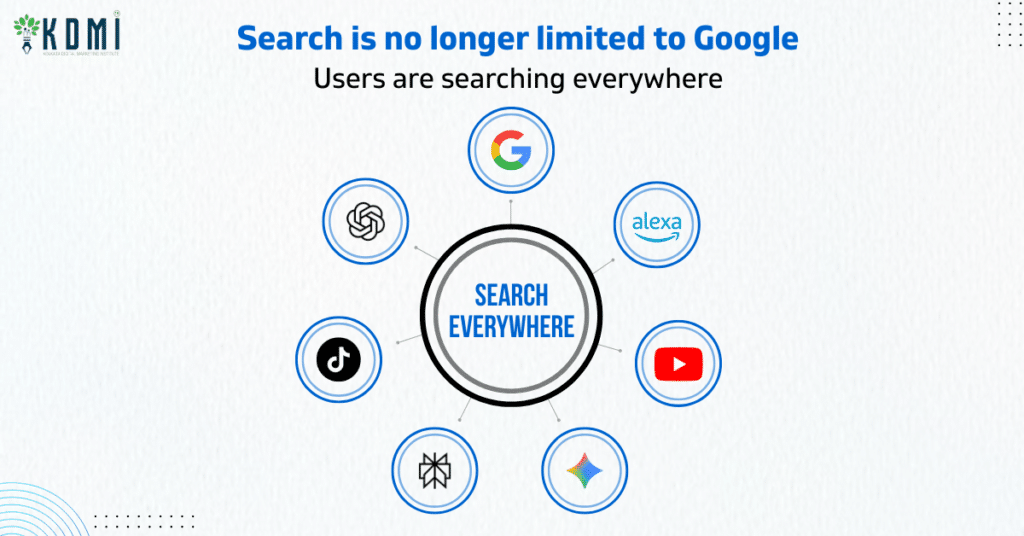
We’re Entering the Era of Search Everywhere
Search is no longer limited to Google’s results page.
Today, users seek credible information, reviews, and recommendations across various platforms, including AI chatbots, voice assistants, and social networks. Your brand must now be discoverable wherever users are searching for trusted answers.
Recent research highlights that, according to new data from Semrush, traffic from LLMs is expected to surpass traditional Google Search by the end of 2027.
Meanwhile, Google’s AI Overviews are generating tens of millions of new impressions as the platform redefines how answers appear in search results.
As GEO continues to reshape SEO and digital marketing, I’ll guide you through the fundamentals to help you understand these changes and stay ahead in an evolving landscape.
What is Generative Engine Optimization (GEO)?
Generative Engine Optimization, or GEO, is the practice of creating and optimizing content. Hence, it appears in AI-generated answers on platforms like Google AI Overviews, ChatGPT, Perplexity, Gemini, and Copilot.
In simple terms, GEO helps your brand show up when users ask questions through AI-powered search tools, not just on traditional search results pages.
GEO goes far beyond traditional SEO. It is a holistic approach to building visibility and authority in the era of AI-driven discovery.
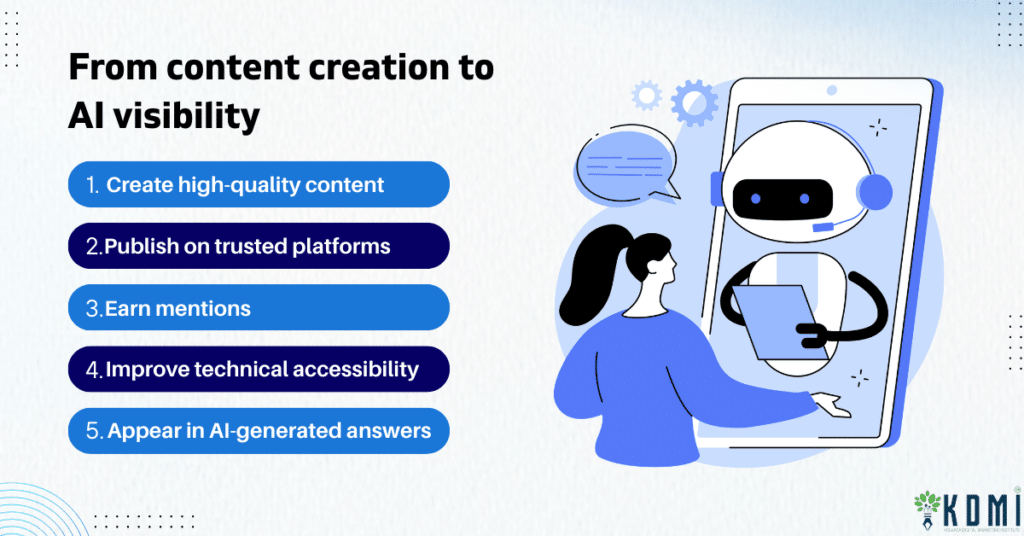
How GEO Works
AI tools such as ChatGPT and Google AI Overviews do more than list links. They generate complete answers in conversational language. That means your content must not only rank but also influence what AI says about your brand, products, or services.
To achieve this, GEO focuses on:
- Creating high-quality, conversational content that answers real user questions naturally and contextually
- Publishing content in the right places where AI systems can easily find and reference it
- Earning brand mentions across trusted platforms, even when they do not include direct backlinks
- Improving technical accessibility so AI crawlers can easily understand and interpret your website.
When implemented effectively, GEO ensures your brand becomes part of the AI-generated conversation that users rely on for decision-making.
Why GEO Matters
Traditional Google search still dominates and will likely continue to drive most of your traffic in the near term. However, the way people discover information is changing rapidly.
Success once meant ranking at the top of the search results page. Looking ahead, there may not even be a “top spot.” Instead, success will mean being the top recommendation — the brand or solution that AI tools choose to feature in their responses.
The data clearly shows how quickly this shift is happening. ChatGPT reached 100 million users faster than any app in history, and as of October 2025, it has over 700-800 million weekly users. These numbers reveal how deeply AI-generated platforms have become part of users’ everyday search behavior.
If your content is not optimized for this new environment, your brand could be left out of what users see and trust. GEO ensures you stay discoverable, credible, and relevant across all AI-powered platforms.
It is not just about being visible; it is about engaging your audience meaningfully, no matter where their search begins.
Ultimately, the goal of GEO is to increase your visibility, attract qualified visitors, and build loyal followers who return to your brand again and again as the digital landscape continues to evolve.
GEO vs. SEO: Similarities and differences
Both Generative Engine Optimization (GEO) and Search Engine Optimization (SEO) play crucial roles in digital marketing today.
While SEO has long been the go-to strategy for increasing visibility on traditional search engines like Google and Bing, GEO is changing how brands appear on AI-powered platforms such as ChatGPT, Perplexity, Gemini, and Google’s AI Overviews.
Understanding how these two approaches align and differ is essential if you want your content to perform well across both traditional and AI-driven search ecosystems.

How GEO and SEO Are Similar
Even though GEO is relatively new, it shares the same foundation as SEO. Both aim to make your brand discoverable, credible, and engaging to the right audience.
Here’s how they overlap:
- Visibility Goals: Both focus on getting your content seen by the right audience and improving overall online presence.
- Keyword Strategy: Both rely on researching and using strategic keywords to enhance discoverability and relevance.
- User Experience: Both prioritize a smooth, enjoyable, and informative experience for visitors.
- Content Quality: Both reward high-quality, valuable, and trustworthy content that aligns with E-E-A-T principles (Experience, Expertise, Authoritativeness, and Trustworthiness).
- Data and Analytics: Both use analytics to understand user behaviour, track performance, and refine strategies.
- Technical Optimization: Both require attention to technical factors such as site speed, mobile responsiveness, and crawlability.
- Authority Building: Both strengthen brand authority through credible content, mentions, and quality backlinks.
- Continuous Adaptation: Both demand flexibility and constant updates to stay ahead of algorithm and technology changes.
In short, GEO and SEO share the same goal: to make your brand visible and valuable to users. The difference lies in where and how that visibility happens.
How GEO Differs from SEO
The biggest difference between GEO and SEO is where your content appears and how it’s discovered.
SEO focuses on optimizing for traditional search engines that show a list of ranked links.
GEO, on the other hand, focuses on optimizing for AI systems that generate answers directly — giving users instant, conversational responses.
Let’s break that down further:
- Response Generation:
SEO optimizes pages to appear in ranked results. GEO optimizes content so AI tools can synthesize it into direct, conversational answers.
- Content Contextualization:
SEO emphasizes keyword placement and metadata. GEO focuses on clarity, structure, and context, enabling AI engines to understand your content and utilize it accurately in generated responses.
- Information Synthesis:
SEO improves the ranking of specific pages. GEO ensures your content contributes to comprehensive answers compiled from multiple trusted sources.
- User Intent Understanding:
SEO matches keywords to user queries. GEO leverages AI’s ability to understand intent, tone, and context to provide more personalized and relevant answers.
- Algorithm Adaptation:
SEO adjusts to Google’s algorithm updates. GEO adapts to how different AI systems learn, reference, and prioritize content.
- Content Formatting:
SEO focuses on titles, tags, and schema markup. GEO ensures your content is structured so AI can easily parse, cite, and repurpose it in natural language.
- Research and Performance Tracking:
SEO tracks keyword rankings, clicks, and impressions. GEO tracks citations, mentions, and referral traffic from AI engines to understand how generative platforms surface your content.
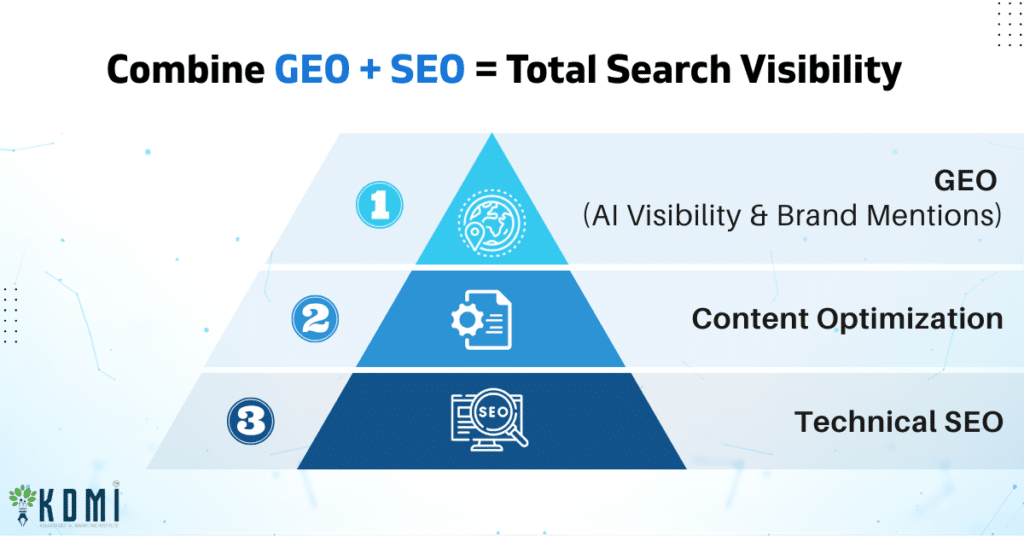
Integrating GEO with SEO: The Future of Search Strategy
While Generative Engine Optimization (GEO) is emerging as its own powerful digital marketing strategy, it works best when combined with Search Engine Optimization (SEO).
Think of SEO as the foundation and GEO as the evolution. Both share common principles, but together they can dramatically boost your online visibility across traditional search engines and AI-driven platforms.
Traditional SEO builds the groundwork that GEO can expand upon. When integrated strategically, they create a unified search strategy that helps your brand appear wherever your audience is looking, whether on Google, ChatGPT, Perplexity, or any other discovery platform.
How to Combine GEO and SEO Effectively
Here are some practical strategies to make GEO and SEO work hand in hand:
- Unified Content Strategy:
Create content that performs well on both traditional search engines and AI-powered platforms. Focus on quality, relevance, and E-E-A-T principles.
- Holistic Keyword Research:
Expand beyond traditional keyword lists. Include semantic keywords, natural language queries, and contextual phrases that align with how people speak and how AI engines interpret intent.
- Technical Excellence:
Keep your website fast, mobile-friendly, and technically optimized. Incorporate structured data, ensure smooth crawling, and make your content readable by both search bots and AI models using natural language processing (NLP).
- Continuous Learning and Adaptation:
SEO algorithms and AI technologies evolve constantly. Stay updated with both worlds and adjust your strategy to match emerging trends and changes in search behavior.
- Data Driven Insights:
Use analytics from both SEO and GEO platforms to track visibility, engagement, and AI-generated mentions. Integrate these insights to refine your overall content and optimization approach.
The future of search is hybrid, and mastering both SEO and GEO is the key to staying visible in it.
Simply, we can say that when you combine GEO and SEO, you make your content easier to find and more engaging.
SEO helps you rank higher on search engines, while GEO helps you appear better on AI-driven results. Together, they build trust, visibility, and lasting audience connections.

Why GEO Matters
GEO is becoming more important as AI-powered search keeps growing.
The early buzz around AI in search has now settled, and we’re entering a stage where people’s trust is stronger and the technology is becoming more reliable.
In today’s competitive space, Google is no longer the only major player. It now faces tough competition from Bing’s AI tools, ChatGPT, Perplexity, and other advanced AI platforms.
How It Impacts Organic Search
AI is changing how organic search works, and businesses need to adjust their marketing approach to keep up.
According to Gartner, traditional search volume could drop by 25% by 2026, and organic search traffic might fall by over 50% as more people start using AI-powered search.
Also, 79% of users are expected to use AI-enhanced search within the next year, and 70% already trust the results they get from generative AI.
This means relying on traditional SEO alone is no longer enough. Brands must combine GEO with SEO to stay visible, attract attention, and build trust on AI-driven platforms.
How User Search Behavior is Changing
GEO is becoming essential because AI-powered search is completely changing how people look for and use information. More users now begin their searches directly on AI platforms — whether they’re looking for answers, researching products, or making purchases.
For instance, ChatGPT now has over 180 million monthly active users, and Perplexity AI’s search traffic has grown by 858% in the last year, reaching around 10 million monthly users.
This major shift shows that people are increasingly trusting AI tools to deliver fast, accurate, and personalized information. As AI becomes a regular part of daily life, these platforms are quickly becoming the first choice for finding information.
By optimizing your content for AI engines, you can reach users where they are most active. Focus on creating helpful, relevant, and high-quality content that AI can easily understand and recommend.
This approach ensures your brand stays visible, engaging, and competitive in the evolving search landscape.
Top Benefits of GEO
Here’s why GEO (Generative Engine Optimization) is becoming a must-have in modern digital marketing and how it can help your brand grow:
1. Reach a Wider Audience
GEO helps your content appear not only on Google but also across AI-driven search platforms. As more users shift to tools like ChatGPT or Perplexity, optimizing for these platforms ensures your content reaches a broader and more engaged audience.
2. Improve User Experience
GEO makes your content easier for AI to understand and share. This allows AI systems to deliver quick, accurate, and personalized answers, which boosts user satisfaction and trust. By understanding user intent and context, AI can connect people with your content more effectively.
3. Gain a Competitive Edge
Adopting GEO early gives your brand a first-mover advantage. It helps position you as an industry leader in a fast-evolving space and builds your reputation as a forward-thinking and innovative brand.
4. Build Brand Authority and Credibility
When your content is optimized for AI platforms, it’s more likely to be included in AI-generated responses. This increases your visibility and credibility as a trusted source. By focusing on clear entities like topics, people, or places, you ensure that AI systems represent your brand accurately and authoritatively.
5. Get Deeper Data Insights
GEO provides advanced metrics that show how users interact with your content through AI systems. These insights help you refine your strategies, improve content relevance, and boost engagement.
6. Future-Proof Your SEO Strategy
Search technology is changing rapidly. Integrating GEO with your SEO ensures your brand stays adaptable and visible across both search engines and AI platforms. It helps secure your online presence and keeps you competitive as AI continues to shape the future of search.
GEO Benefits in Action
A study by researchers from Princeton, Georgia Tech, The Allen Institute for AI, and IIT Delhi looked at more than 10,000 search queries to understand how Generative Engine Optimization (GEO) improves visibility in AI search results. The study showed that even small, smart content changes can make a big difference in how often your content appears in AI-generated answers.
Key GEO Strategies That Work:
- Cite reliable sources to build trust and credibility.
- Add statistics to make your content stronger and more convincing.
- Use expert quotes to show authority.
- Write in simple, clear language so it’s easy to understand.
- Keep your text smooth and accurate for better readability.
The study found that citing sources, adding quotes, and using statistics improved visibility by 30 to 40 percent with very little effort.
Industry-Specific Insights:
- Science, debate, and history: Use technical terms and an expert tone.
- Business and health: Make content fluent and clear.
- Law and government: Use credible citations and verified facts.
- Society and education: Add expert quotes for better visibility.
While some experts questioned parts of the research, the results still highlight one clear point — GEO can increase your visibility, credibility, and audience engagement.
As AI-driven search keeps growing, combining SEO basics with GEO techniques will help your brand stay visible, relevant, and ahead in the digital space.
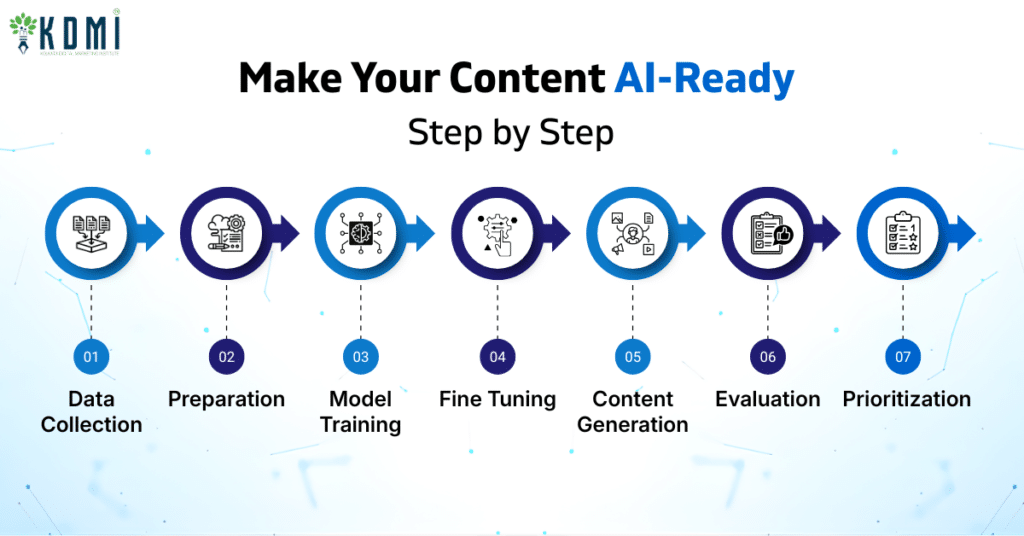
How to Optimize Content for GEO
Well, to know the optimization process, you first have to understand how Generative AI and Answer Engines work.
Generative AI engines use large amounts of data to create clear, complete, and conversational answers to user questions.
Unlike traditional search engines that simply show web page links, these AI systems understand intent, context, and meaning, using advanced machine learning models to generate direct and useful responses.
Here’s a simple explanation of how this process works:
1. Data Collection
The AI gathers information from multiple reliable sources to build a large and accurate knowledge base.
2. Data Preparation
This data is then cleaned, organized, and standardized by removing duplicates or errors, ensuring it is ready for model training.
3. Model Training
Machine learning models are trained to understand human language by recognizing patterns, context, and user intent.
4. Fine Tuning
Once trained, the model is fine-tuned for specific industries, topics, or tasks to provide more accurate and context-rich answers.
5. Content Generation
When a user asks a question, the AI combines information from its knowledge base to create a natural and conversational response instead of just a list of links.
6. Evaluation and Improvement
Each response is reviewed for accuracy, relevance, and clarity. The AI uses this feedback to improve over time.
7. Prioritization
Finally, the AI prioritizes content based on its relevance, quality, and trustworthiness, ensuring users get the most helpful answers first.
By understanding this process, you can optimize your content for GEO by making it easier for AI engines to find, understand, and include your content in their responses. This approach helps improve visibility, credibility, and user engagement in AI-powered search results.
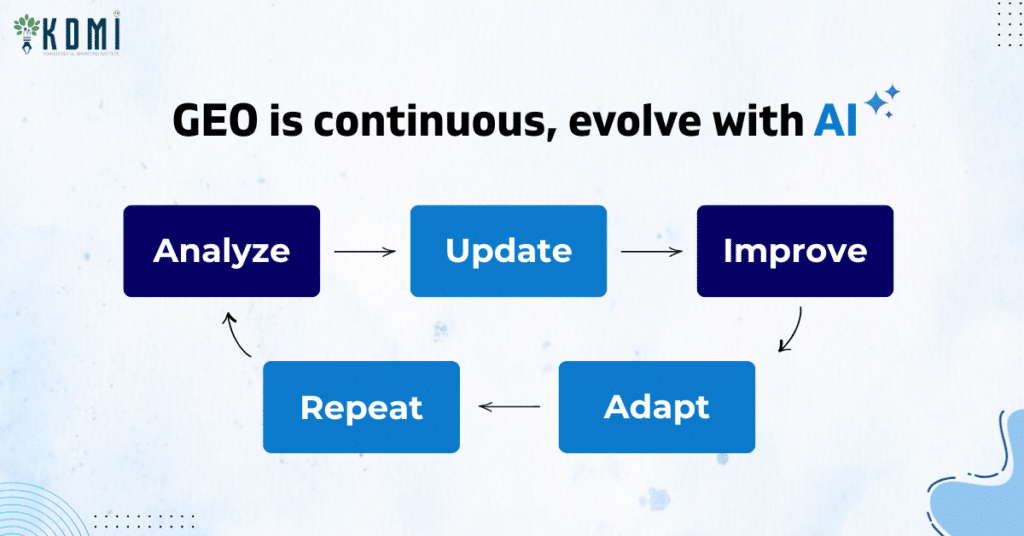
GEO is an Ongoing Process
GEO is not a one-time setup but a continuous and evolving process. Like SEO, it needs regular monitoring, testing, and updates to keep your content relevant in the fast-changing world of AI-driven search.
The goal is to ensure your content always matches user intent and stays visible across both traditional and generative platforms.
Think of GEO as a long-term investment rather than a quick solution. AI tools such as ChatGPT, Gemini, and Perplexity are constantly learning and improving, which means the way they understand and present content also keeps changing.
To stay ahead, your strategy must grow and evolve with them.
Here is how to make GEO an ongoing part of your content strategy:
1. Review and Analyze Regularly
Track how your content performs in both Google and AI-generated search results. For example, if your blog on “best dental implant aftercare tips” starts losing engagement, it might be time to refresh it with updated information, better structure, and new expert references that AI can identify and use.
2. Update for Relevance
AI platforms prefer fresh, fact-based, and context-rich content. Regularly update key pages and blogs with the latest statistics, examples, or user insights. For instance, a digital marketing agency can revisit its “SEO trends 2025” article every few months to include recent algorithm updates or client success examples.
3. Use Data and Feedback Loops
Pay attention to user interactions, engagement time, and feedback from AI chat results. If people keep asking follow-up questions about your topic, it means your content might need clearer explanations or an FAQ section. Real user behavior gives you clues on how to refine your next update.
4. Adapt to AI Evolution
As generative AI tools become more advanced, they prioritize content that is truly helpful, credible, and well-structured. For example, if Perplexity AI starts focusing more on verified and cited content, make sure your blogs include links and references from reliable and trusted sources.
From this, we can easily conclude that GEO is about listening, learning, and improving. Keep your audience at the center of your strategy. Their behavior and feedback will guide you on what works best.
The more you adapt to their needs and AI’s changing behavior, the more visible, engaging, and trustworthy your content will become in this new era of search.

Future Potential of GEO
The future of GEO is incredibly promising as AI becomes a core part of daily life. A recent McKinsey survey reveals that 65% of organizations now use generative AI regularly, nearly double the number from just ten months ago.
This rapid adoption shows how deeply AI is transforming how people search, learn, and make decisions online.
Here’s what the future holds with real-world examples for better understanding:
Smarter AI Experiences
AI won’t just answer your questions; it will start anticipating your needs.
Example: Imagine asking ChatGPT for “healthy dinner ideas,” and it suggests recipes based on your previous dietary preferences, nearby grocery store availability, and even your fitness goals from your smartwatch data. That’s proactive GEO in action.
Voice and Visual Search
Voice assistants like Google Assistant and Amazon Alexa are already changing how people search. Similarly, Google Lens lets users find information by simply snapping a picture.
Example: A user clicks a photo of a plant and instantly learns its name, care routine, and nearby shops selling it thanks to AI-driven GEO optimization.
Seamless Integration
Generative AI will soon merge with augmented reality (AR) and other tools to deliver immersive, real-time information.
Example: A tourist in Paris could point their phone at the Eiffel Tower and instantly get a short AI-generated history summary, nearby restaurants, and ticket-booking links, blending online and offline experiences.
Hyper Personalization
AI will provide ultra-personalized answers based on each user’s preferences, behavior, and context.
Example: Spotify’s “AI DJ” uses generative AI to curate playlists tailored to your mood and listening habits. GEO will bring this same personalization to search results.
Multimodal Search Evolution
Future searches will combine text, images, audio, and video, offering more interactive and rich results.
Example: You might search “how to fix a leaking tap,” and instead of getting a blog post, you receive a mix of short tutorial clips, voice instructions, and summarized text guidance created through GEO-powered AI.
In short, the future of GEO is not just about ranking content; it’s about creating meaningful, personalized, and AI-friendly digital experiences. Those who embrace this evolution will lead the next generation of search visibility and user engagement.
You Need to Start Now to Stay Visible
The AI search landscape is changing rapidly, with new features and updates rolling out almost every month. To stay visible and competitive, you can’t afford to wait—the time to act is now.
Start by tracking your current SEO performance so you have a clear benchmark. This will help you identify how your content performs in AI-generated results and uncover new opportunities as generative AI search continues to evolve.
To grow your online presence, it’s essential to layer GEO (Generative Engine Optimization) on top of your existing SEO strategy:
- Keep optimizing for traditional SEO signals — continue building strong rankings, backlinks, and authority because AI engines still rely heavily on these factors.
- Adapt content for AI-first visibility — focus on creating content that AI platforms can easily reference, summarize, and display directly in their responses.
By integrating GEO into your digital marketing approach today, you’ll ensure that your brand remains visible, trusted, and ready for the future of search.
Conclusion
The future of search is already here and AI powers it. Generative Engine Optimization helps your brand stay visible as users shift to AI platforms like ChatGPT and Perplexity. Start optimizing now to stay ahead, build trust, and ensure your content gets featured in AI-generated answers. The earlier you adapt, the stronger your online presence will be.

your perspective feels realistic, which makes the hopeful parts hit more
your perspective feels realistic, which makes the hopeful parts hit more
I appreciate how well-researched and informative each post is It’s obvious how much effort you put into your work